How STAMP's conveyor belt speeds up: difficulty, bursts and the 60-second jolt
STAMP's belt goes from 240 to 750 speed units as your score climbs to 1,000. Here's how difficulty, box bursts, speed jolts and Easy/Normal/Hard really work.

STAMP is a free mobile arcade game for iOS and Android where you stamp packages on a conveyor belt, and the belt never stops getting harder. There are no levels: a run is one endless shift that speeds up until your performance bar hits zero. We checked the game’s code to write down exactly how that ramp works, so you know what’s coming.
How does the difficulty rise in STAMP?
Difficulty is tied to your score. It starts at zero and reaches its maximum at 1,000 points. Everything below moves smoothly between a starting value and a maximum value along that line:
- Belt speed: from 240 to 750 (in the game’s own units).
- Time between boxes: from 2.4 seconds down to 0.7 seconds.
- Music: the soundtrack speeds up with the belt, up to 1.3 times its normal tempo.
- Box mix: the plain Common box gets rarer and the tricky ones show up more often. If you haven’t read it yet, How to play STAMP explains each package.
There’s no sudden jump. The belt just keeps getting a little faster, which is why a run feels fine until it suddenly doesn’t.
What is the performance bar?
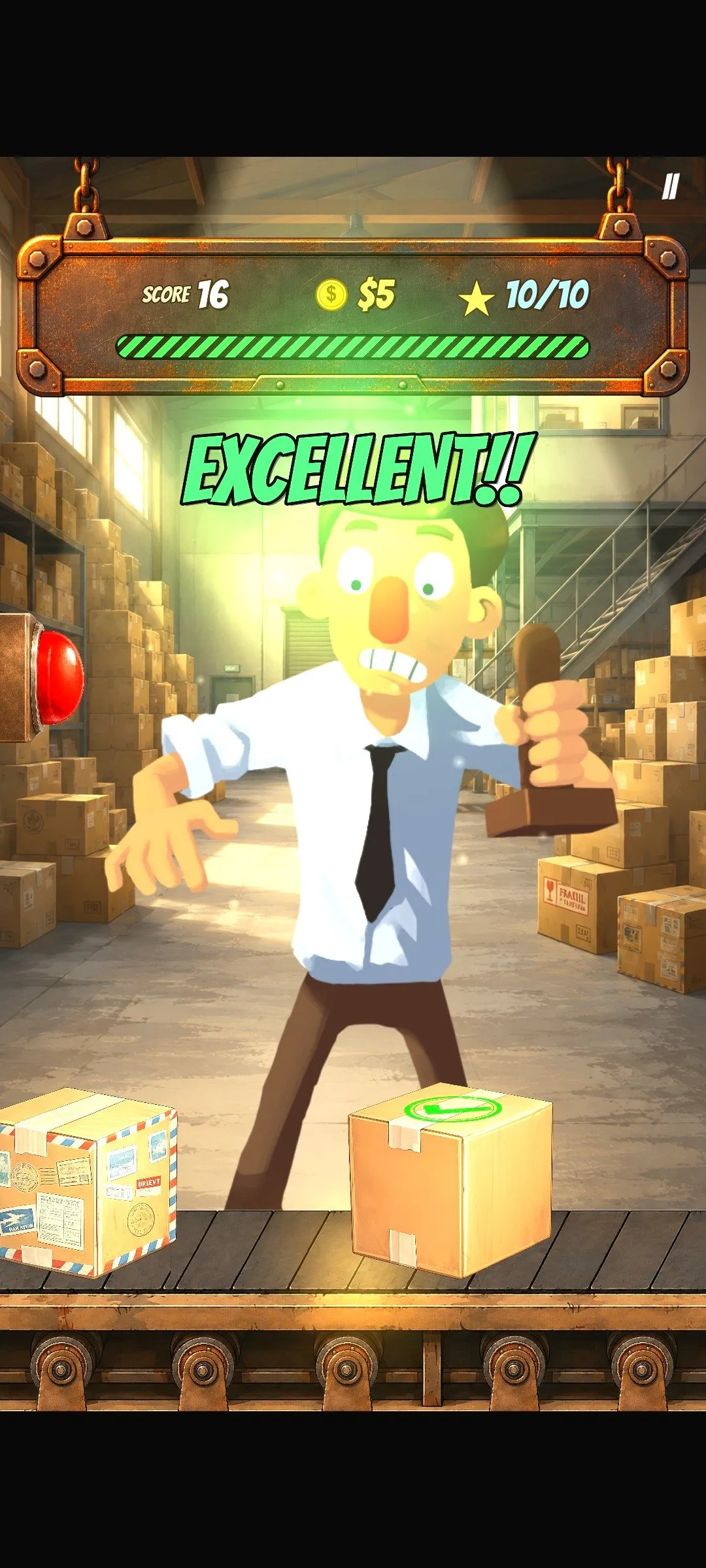 A full bar: everything is under control.
You start every run at 100 performance. A hit gives some back; a normal miss costs 15. At zero, the shift is over. Because a miss takes a big chunk, two or three mistakes in a row are the usual way a long run ends.
Hits also come in two grades. An EXCELLENT stamp pays full points. A stamp that lands but isn’t centered (the game says GOOD instead of EXCELLENT) pays 60% of the points and coins.
What are box bursts?
Past 35% difficulty (around 350 points), boxes can start arriving in bursts of 2 or 3 with much shorter gaps between them. The chance of a burst grows with difficulty, up to 35% per spawn. After a burst there’s an extra one-second breather. Boxes never overlap: the game always leaves a minimum gap, however fast things get.
What is the 60-second speed jolt?
Every 60 seconds of real play, the belt gets a jolt. First you get a warning: sparks and a sound, about a third of a second ahead. Then the belt stutters for around half a second. It’s timed on real playing time, not on score, so jolts stay evenly spaced and never pile up at high difficulty. It’s there to break your rhythm on purpose.
Do SOS boxes and BANAS change over a long run?
Yes, two things are tuned for long runs:
- SOS gets rarer after 4 minutes. Each SOS box pauses the belt when you press EMERGENCY, which is basically a rest. So after 240 seconds the chance of an SOS starts fading, over the next 180 seconds, down to about a third of its normal weight, so long runs get harder instead of easier.
- BANAS shows up on a schedule. The first golden box can appear from about 25% difficulty (250 points). The second needs 70% difficulty (700 points) and at least 75 performance. After that, it can return roughly every 90 seconds.
What do Easy, Normal and Hard change?
The difficulty option in Settings multiplies the curve above:
| Setting | Belt speed | Time between boxes |
|---|---|---|
| Easy | ×0.85 | ×1.3 (more room) |
| Normal | ×1.0 | ×1.0 |
| Hard | ×1.2 | ×0.75 (less room) |
Does a game over reset the belt?
Not completely. If you lose, the next run starts with 60% of the difficulty you reached, so you don’t go back to a slow belt after a great run. It only lives in memory: close the app and the next run starts calm again.
Tips for the ramp
- Learn the early belt as rhythm practice. The first minute is slow on purpose.
- Expect the jolt at 60 seconds, and don’t panic when sparks fly.
- Protect your performance before chasing points. The second BANAS needs 75 or more.
- Try Easy to learn the boxes, then move up.
STAMP is free on iOS and Android. See how far the belt goes before Gary’s shift ends.
Latest from the blog

How to play STAMP: every package type and how to stamp it
Common, Fragile, International, SOS and the rare golden BANAS box: the move each package needs, what it's worth and the mistakes that cost Gary his shift.
Read post →
Gary Needs a Job: how STAMP's story begins (S1E01)
Episode 1 of the STAMP series: a packed lunch, the classifieds and one very honest job market. Here's what happens, the joke, and how the 33-second Short was made.
Read post →